The Wealth of Nations and the Reciprocal Tariffs
Among the dates and names that will mark world history, there is no doubt that 2025 and Donald Trump will be included. Facing the pivotal moment that history is currently experiencing, of which we are writing the initial lines, one date and two names emerge: 1776, Adam Smith, and Thomas Jefferson.
On March 9, 1776, Adam Smith published The Wealth of Nations, earning his place in history as the father of economics. A few months later, on July 4, 1776, Thomas Jefferson signed the Declaration of Independence, liberating the Thirteen Colonies from the rule of England.
In 2026, we will celebrate the 250th anniversary of these writings and a year of presidency under the visible hand of Donald Trump. The collision of these anniversaries will create sparks, resulting in a clash of ideas between the progressive past and the nostalgic present.
The Wealth of Nations and the Declaration of Independence
Thomas Jefferson read The Wealth of Nations, which he regarded as the best book on money and trade. In this work, Adam Smith introduced several innovative ideas for his time. First, he criticised mercantilism and advocated for free trade and the division of labour. He supported a limited government that protected private property and enforced laws to ensure markets operated fairly.
In the Declaration of Independence, signed by Thomas Jefferson, the thirteen Colonies united and liberated themselves from the yoke of the United Kingdom. This political document outlines the deprivations and prohibitions that George III imposed on the Colonies in the New World, preventing men, who are all created equal, from pursuing inalienable rights such as life, liberty, and the pursuit of happiness. "Whenever any Form of Government becomes destructive of these ends, it is the Right of the People to alter or to abolish it, and to institute new Government, laying its foundation on such principles and organizing its powers in such form, as to them shall seem most likely to effect their Safety and Happiness."
The Independence of Wealth and the Declaration of Nations
In his rewriting of history, Trump interchanges words and perverts the meaning of the founding texts. When we commemorate the Wealth of Nations and the Declaration of Independence in a year, we will also reflect on the first year of the Trump 2.0 presidency.
Over the last 75 years, the wealth of the United States has grown enormously. Real GDP has increased by a factor of 11.1, real disposable household income by 11.7, and real household wealth by 16. Wealth accumulation has accelerated since the late 1970s, reaching 7.7 times disposable income and 5.7 times GDP, as shown in Figure 1.
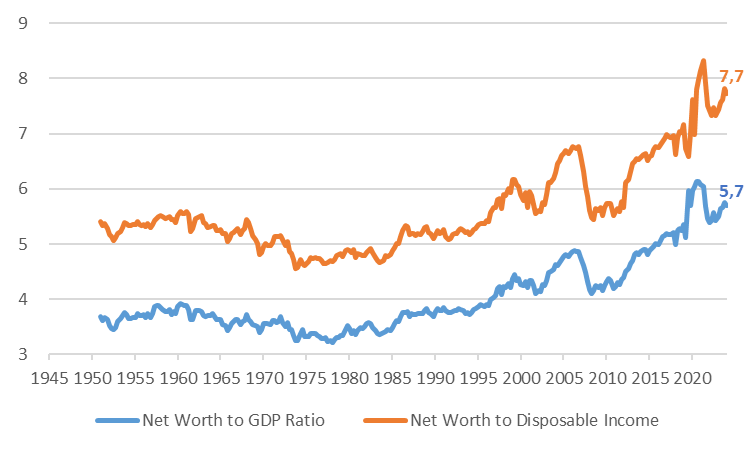
American households have greatly benefited from global economic prosperity, especially over the last 50 years. However, this prosperity has not been evenly distributed among the population, as any visitor to this beautiful country quickly observes. The Gini index confirms that inequality has increased over the past 50 years as wealth accumulation has accelerated.
The problem is thus the distribution, not the creation of wealth. Imposing tariffs is inappropriate and dangerous for the United States (and the rest of the world). With stagflation or recession looming, tariffs will directly impact American households by reducing purchasing power and fueling existing social tensions.
For billionaires, the implementation of tariffs is not good news either. The world's ten largest fortunes, most of which are American, have lost a staggering USD 74 billion in the three days following Liberation Day, according to Business Insider. Among the big losers are Jeff Bezos and Elon Musk, with losses of USD 16 billion and USD 11 billion, respectively. Musk has just announced that the tariffs were "a huge policy mistake". Oops!
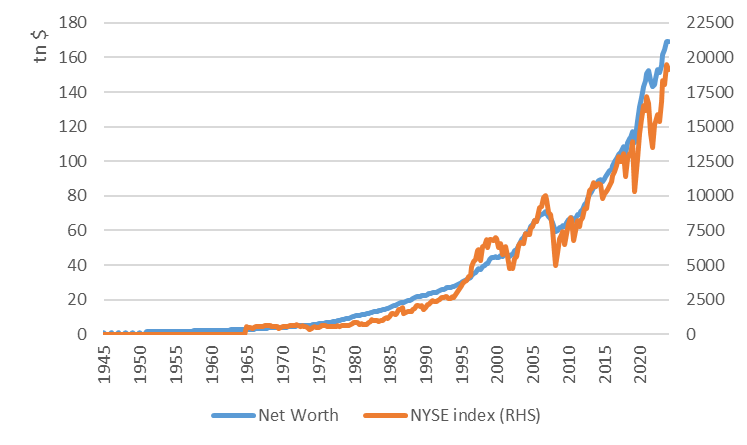
Beyond this big loser's personal anecdote, American households' wealth is closely tied to the equity market: the correlation is 0.71 (Figure 2). A third of household assets are in real estate, while the remaining two-thirds consist of financial assets, half of which are equities.
As Adam Smith wrote nearly 250 years ago, free trade and the division of labour are sources of prosperity and wealth. Barriers to international trade hinder growth and slow the accumulation of wealth. There is no independence of wealth nor mercantilism.
Finally, let us return to Thomas Jefferson and the Declaration of Independence. The concentration of power in the hands of Trump 2.0 and his desire to run for a third term are serious enough for bookmakers to give him an 18% chance of success, according to a recent article in the Financial Times. If this were the case, we would change regimes, transform Trump 3.0 into Trump III, and draw closer to George III of the Declaration of Independence than to a declaration of nations through the ballot box.
Conclusion
By preaching excess, Trump hopes to gain a lot. However, asking excessively also involves the risk of a rupture. The President's latest about-face, which entails imposing tariffs of 10% for 90 days, except for China (125%), indicates that he cannot dictate terms unilaterally.
Is 10% a success for Trump and a victorious defeat for the rest of the world? We all lose with tariffs. The game of negotiations, threats, retaliations, and, ultimately, concessions begins. Trump congratulated himself for imposing a 10% tariff on the global economy and punishing China, somewhat reassuring his base and diffusing tensions within his administration.
Except for China, the rest of the world appreciates this respite, which carries the bitter-sweet taste of a victorious defeat. After all, 10% is the lowest possible reciprocal tariff. We thank the financial markets for sounding the alarm in unison.
Regardless of the final outcome of the negotiations, the introduction of tariffs signifies the start of a new era that will permanently change the wealth of nations.
This article is a translation of a column originally published in French on Allnews.ch.
← All publications