AI is not a Bubble. But your Portfolio might be.
Artificial intelligence is a major technological revolution, and the elevated valuations of the American companies driving it reflect the hopes placed upon it. At a quarter-century's distance, the internet revolution shares important parallels. That revolution did materialise — yet it also fuelled a financial bubble that ultimately burst. Between hope and realisation, timing matters.
What the internet numbers tell us
Between 1996 and 2000, telecoms operators and equipment manufacturers (Cisco, Lucent, Nortel) collectively invested more than $500 billion in the infrastructure of the new economy. Annual capex peaked at around $213 billion in 2000, representing just over 1% of US GDP — a historic level. The technology sector's weight in the S&P 500 rose from under 10% in 1995 to 33% in March 2000.
The conviction that a large-scale technological revolution was materialising translated into elevated market capitalisations. Ultimately, US total factor productivity accelerated from 2.1% per annum in the 1990s to 2.8% in the period following the dotcom bust and preceding the Great Financial Crisis, as the chart below illustrates. That is the clearest macroeconomic confirmation that a technological revolution did occur.
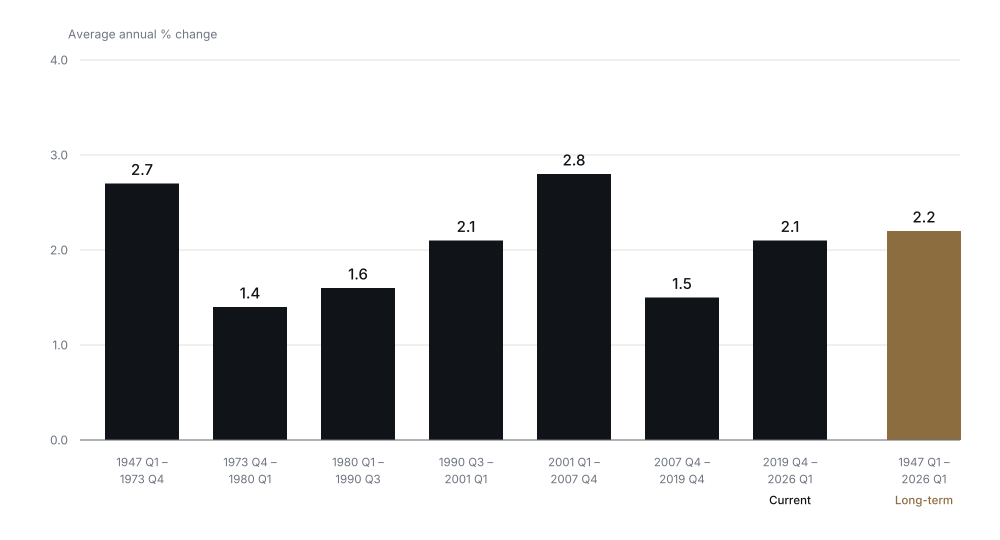
But the tension lies in the timing. The Nasdaq peaked in Q1 2000, while productivity peaked in 2004. During those four years, the tech index lost nearly 80% of its value, and much of the fibre laid during the boom lay unused — the famous "dark fibre."
In other words, markets over-anticipated the revolution, the technology delivered, and the real economy benefited — and continues to do so today, since it is what allows everyone to use AI. Also, the visionary investors who held the index still lost. The thesis was right, but the timing killed portfolios.
The parallels with 2026
The current investment effort is of comparable magnitude. Microsoft, Alphabet, Amazon, Meta and Oracle plan between $660 and $725 billion in capex for 2026 (just under 1% of GDP), after collectively rising from $160 billion in 2023 to over $410 billion in 2025, with roughly three quarters dedicated to AI infrastructure. As the chart below shows, the share of IT-sector investment in total S&P 500 investment is even more concentrated today than it was in the early 2000s.
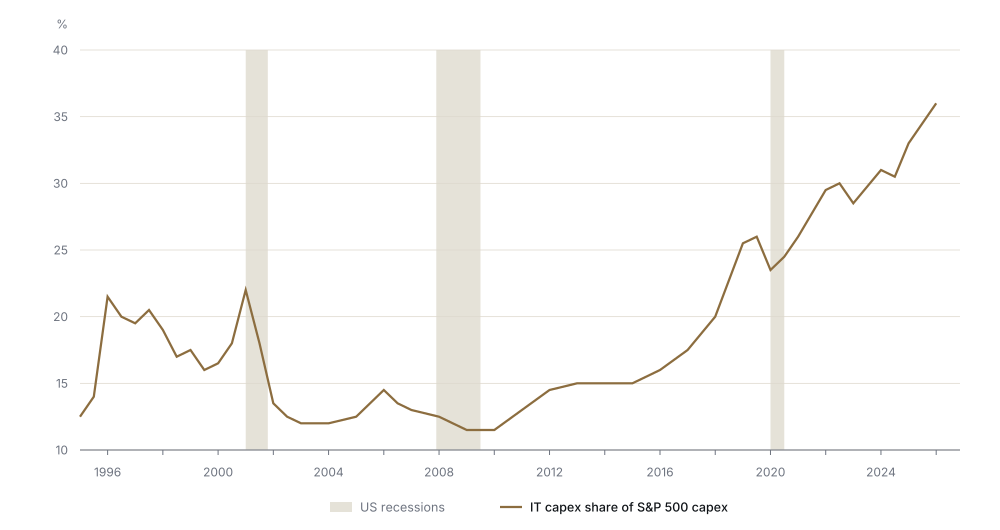
The technology sector now represents one third of the S&P 500, and the Magnificent Seven alone account for nearly 35% of the American index and a quarter of the MSCI World. In terms of capital concentration and investment intensity, the parallel with 2000 is direct.
To this must be added the same temporal asymmetry. Between 2019 and 2026, US productivity grew at an average of 2.1% per annum — as it did during the 1990s. According to the Bureau of Labor Statistics, total factor productivity has been decelerating for three consecutive years: 2023: +1.7%, 2024: +1.6%, 2025: +0.8%.
As long as this gap remains unresolved, the AI thesis awaits macroeconomic confirmation, and the tension between equity valuations and reality continues to build.
Differences that matter
Several elements do distinguish 2026 from 2000, and they are not trivial. The Magnificent Seven carry average net margins of around 28%, versus 16% for the tech leaders of 2000 — a significant portion of which were loss-making. The group's forward P/E is close to 24x, versus 52x at the 2000 peak; Nvidia trades around 40x, where Cisco reached 200x. The hyperscalers fund their capex predominantly from operating free cash-flow. While some circular financing is also observed, the late-1990s telecom boom relied far more heavily on vendor financing — Lucent, Cisco and Nortel effectively financing their own customers — an industrial Ponzi scheme that collapsed as soon as investment flows slowed. Finally, where the optical fibre of 2000 largely went unused, demand for AI compute capacity today exceeds supply: Microsoft has publicly acknowledged an $80 billion Azure backlog it cannot fulfil for lack of electricity.
The contrast is real. However, these more favourable fundamentals do not shelter investors from timing risk. The risk embedded in current valuations is not that AI is a mirage — it is that its productivity gains, like those of the internet, may take time to materialise in the macroeconomic data, while markets demand confirmation on a much shorter horizon. A multiple compression can occur even as earnings continue to grow. That is precisely what happened between 2000 and 2004.
The silent trap of passive portfolios
For investors, this risk is largely implicit and underestimated. Take the MSCI World as a global passive equity portfolio. It is approximately 70% US equities, of which around 25% are in the Magnificent Seven — meaning 17 to 18% of the overall portfolio is concentrated in just seven companies. The apparent geographic diversification of the MSCI World is largely an illusion; its sector diversification even more so.
Yes to AI, but intelligently
First, measure Magnificent Seven exposure explicitly, line by line, including within index mandates — the figure frequently exceeds what investors assume. Second, consider equal-sector-weighted or diversified-sector-weight versions of major indices as mechanical tools for capping concentration without abandoning the theme. Third, integrate buffers whose performance does not depend on the timing of AI productivity gains: defensive European and Swiss quality equities, listed infrastructure, gold, and Swiss franc exposure — whose role as a shock absorber in risk-asset stress remains solid.
The internet precedent does not say AI will fail — quite the contrary. It says that the investors who won from that revolution were those who had the wisdom to revisit their allocation while things were still going well.
This article is a translation of a column originally published in French on Allnews.ch. Read next: AI, a virus in search of a metabolism.
← All publications