AI, a virus in search of a metabolism
Humanity believes it is witnessing the birth of a new form of life. According to a thought-provoking article in The Economist (How artificial intelligence got better at building itself), artificial intelligence could, by the end of 2028, reproduce on its own, without human intervention — enough to tick several boxes in the definition of life. The thesis is seductive, and it is through this unexpected detour that it meets my usual territory, macro. Because it is false: AI is not an organism, it is a virus.
A virus, not a living organism
Reproduction has never been enough to define life: a crystal seeds other crystals, with no life whatsoever. The decisive criterion is metabolism — an organism's ability to source, convert and regulate its own energy to maintain its order against disorder, and to repair its own parts.
Yet AI metabolises nothing. It replicates and consumes electricity to order its code, but it does not produce its energy (it draws it straight from the grid), does not manufacture its chips, does not source its own data. It "lives" only by hijacking a host's machinery to make copies of itself: that is, word for word, the definition of a virus.
Life on a drip
The scale of this dependence is striking. According to the International Energy Agency, data centres consumed 1.5% of the world's electricity in 2024 (415 TWh); that share would double by 2030 (945 TWh, around 3% of the total, the equivalent of Japan).
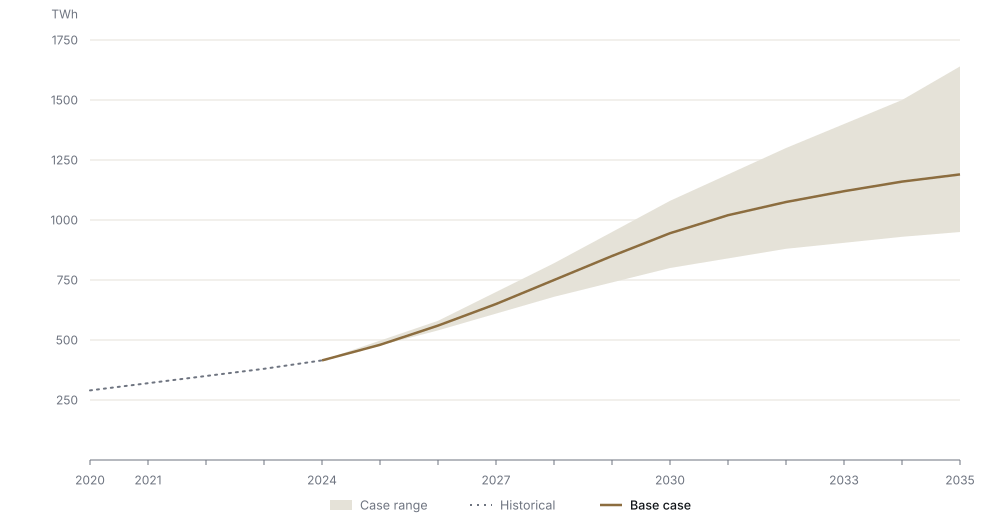
On the capital side, Microsoft, Alphabet, Amazon, Meta and Oracle plan 660 to 725 billion dollars of capex in 2026, close to 1% of US GDP. A "life form" that demands nearly 1% of the leading power's GDP and more than 1.5% of the world's electricity each year merely to sustain itself is not autonomous.
Finally, its dependence on data is total.
Where value accrues
A virus does not devalue its host at random: value flees what it can produce and takes refuge in what it cannot. AI is precisely learning to manufacture part of what it feeds on (data and cognitive labour) — that is where value erodes, the value of human intelligence. Energy, compute and capital, which it cannot produce, become the scarce factors toward which value migrates.
The mechanism is macroeconomic: data-centre demand durably supports the price of energy, while capex draws on global savings and keeps the cost of capital high, as long-term yields signal. Capital is already voting: hyperscalers have signed nearly 10 GW of nuclear contracts (Microsoft, $16 billion over twenty years to restart Three Mile Island; Amazon, $20 billion in Pennsylvania; Meta, up to 6.6 GW). Where the fibre of 2000 was overbuilt on credit, this demand is contracted for twenty years (read my previous article: AI is not a Bubble. But your Portfolio might be).
Then comes the timing asymmetry: in the short run, AI supports the price of energy and capital; in the long run, and only if its productivity gains finally materialise, it turns disinflationary. Feeding the machine is costly before it pays off, which argues for real assets, the energy complex and power producers.
The host keeps the upper hand
No, humanity is not giving life to AI: it has created a prodigious replicator, but one without a metabolism. The hyperscalers' nuclear contracts are precisely the attempt to give it one, by appropriating its own source of energy. As long as they have not succeeded, value remains on the host's side, with whoever owns what AI cannot produce: the megawatts, the chips, the capital. The day it produces its own energy, it will cease to be viral and become alive. That day has not come. Until then, wisdom lies not in fearing the machine, but in owning what keeps it alive.
This article is a translation of a column originally published in French on Allnews.ch.
← All publications